
Key Takeaways
- Distinguish between risk tolerance, a client's behavioral preference, and risk capacity, their financial ability to take risk, to support a more complete client profile.
- Establish firmwide governance for how questionnaire results are interpreted, documented, and used in portfolio conversations to improve consistency across advisors and offices.
- Recognize that behavioral biases, like loss aversion and recency bias, can influence questionnaire results, making periodic re-evaluation an important consideration alongside the initial assessment.
- Bridge the operational gap between completing a risk questionnaire and performing a comparative portfolio analysis to reduce manual work and support a more repeatable advice-preparation workflow.
- Treat the risk tolerance questionnaire as one input within a broader discovery, investment profiling, and documentation process, rather than as a standalone compliance document.
For most advisory firms, the risk tolerance questionnaire for advisors is one of the first inputs gathered in a new client relationship. It can play an important role in documenting a client's behavioral preferences around risk and informing a broader investment profile, but it does not independently establish investment suitability or capture every consideration relevant to a recommendation. Other factors, such as goals, liquidity needs, time horizon, income requirements, and household constraints, also shape the broader profile.
The questionnaire is often completed, a score is generated, and the resulting PDF is saved to a client folder. But the data may go no further. It can remain in a file or a CRM field, disconnected from the comparative portfolio analysis, proposal, and presentation workflows that follow. This creates an operational gap where the advisor manually interprets the result within the context of the broader client profile, and the firm may lose consistency in how that process is documented.
This article examines how advisory firms can move beyond treating the risk questionnaire as a compliance artifact. We will explore the distinction between risk tolerance and capacity, key design considerations, the influence of behavioral finance, and the governance challenges for multi-advisor firms. Most importantly, we will look at how to connect risk profiling to the comparative portfolio conversation, turning a standalone document into a useful input for a more complete advisory workflow.
Why Risk Tolerance and Risk Capacity Are Different Inputs
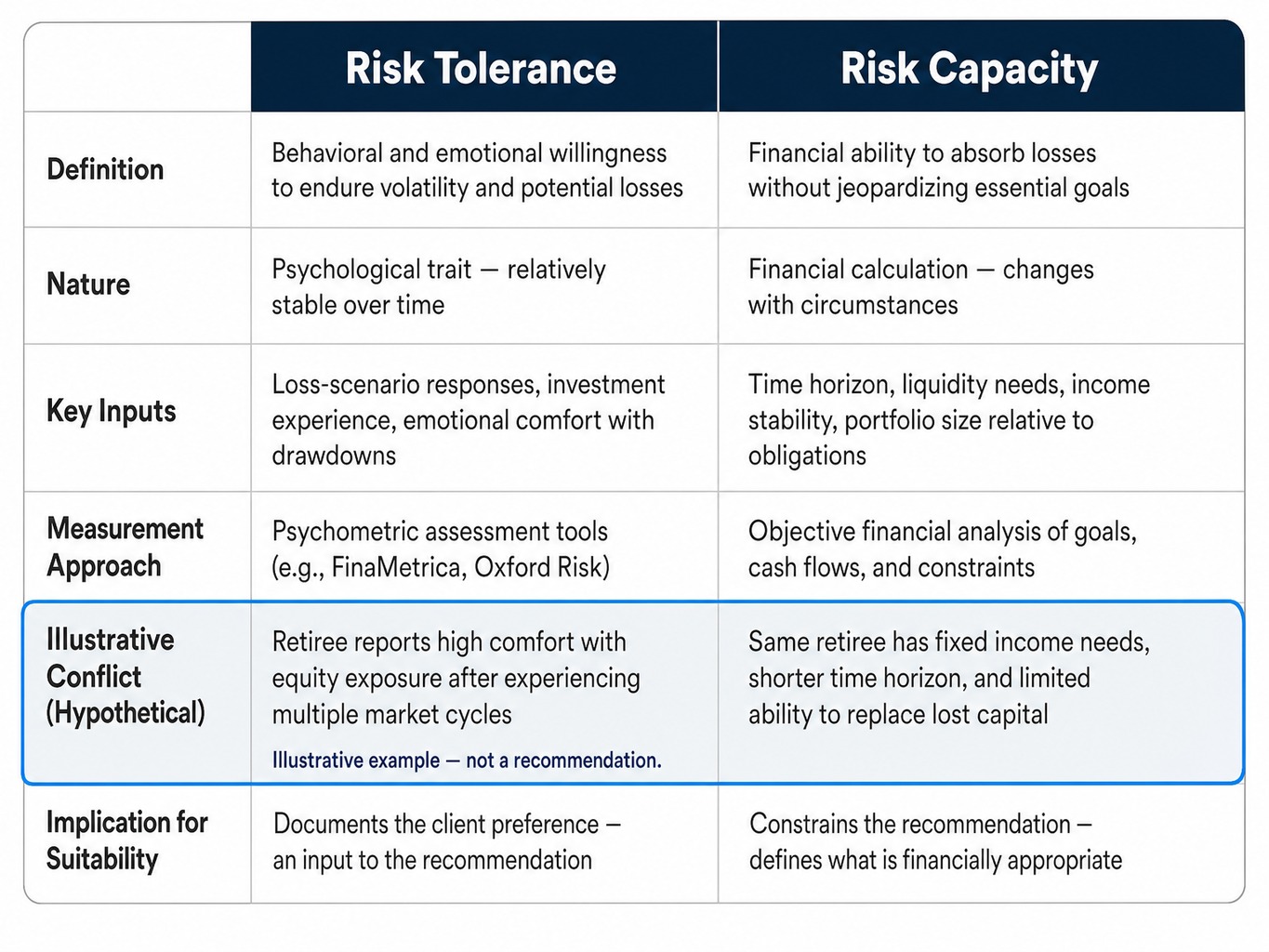
Many standard risk questionnaires blend questions about a client's feelings toward risk with questions about their financial situation, collapsing the answers into a single composite score. While efficient, this can obscure a crucial distinction that affects downstream client profiling and documentation. A client who reports high comfort with volatility but depends on portfolio distributions for living expenses presents a different consideration than one whose tolerance and capacity align. Separating these concepts can support a more nuanced client profile.
Risk Tolerance as a Behavioral Measure
Risk tolerance is the behavioral and emotional dimension of a client's profile, their willingness to endure portfolio volatility and potential losses in pursuit of higher returns. It is a psychological trait that may be relatively stable, though questionnaire results can still be influenced by timing, framing, and market conditions. Some psychometric assessment tools are designed to measure this dimension separately from a client's financial circumstances.
Consider a hypothetical retiree who has a high stated tolerance for risk, having experienced several market cycles. They may report comfort with significant equity exposure. However, their financial situation, a fixed income need, a shorter time horizon, and limited ability to replace lost capital, may constrain how much risk is financially appropriate. Their high tolerance is a preference, but it does not override the broader financial context. A questionnaire that isolates this behavioral preference can help an advisor document it while using other inputs to shape the final recommendation.
Risk Capacity as a Financial Measure
Risk capacity refers to a client's financial ability to absorb losses without jeopardizing essential goals. It is informed by financial analysis rather than by preference alone, and it typically reflects assumptions about income, spending, liabilities, liquidity needs, time horizon, and investment objectives. Rather than a single universal calculation, it is often an evaluative judgment built from several financial inputs.
To illustrate, imagine a business owner who recently sold their company. They may have substantial liquid assets and a multi-decade time horizon, factors that can support greater risk capacity. At the same time, future spending needs, legacy goals, concentrated holdings, or other constraints may still limit how much portfolio risk is appropriate. Behaviorally, they may also be highly loss-averse and become anxious during even modest drawdowns. Their financial capacity and behavioral tolerance point in opposite directions. The CFA Institute's framework for investment risk profiling identifies risk-taking ability (capacity) and behavioral loss tolerance as separate dimensions that require distinct evaluation. A questionnaire design that distinguishes between the two allows advisors to document this tension and build a portfolio discussion that reflects both financial reality and emotional comfort.
What a Well-Designed Risk Tolerance Questionnaire Typically Covers
While the specific questions vary, most comprehensive risk tolerance questionnaires go beyond a single "how much risk can you handle?" inquiry. They assess several overlapping dimensions to build a more complete picture of the client's profile. This multi-faceted approach can support a broader discovery and investment profiling process, but it does not by itself satisfy broader know your client obligations.
Well-designed questionnaires often explore:
- Time Horizon and Goal Specificity: How long does the client intend to invest before needing the funds? Are the goals defined, for example retirement in 20 years, or flexible? A longer time horizon may support greater risk capacity, though other constraints still matter.
- Liquidity Requirements: Does the client anticipate needing to withdraw a significant portion of the portfolio in the near term? High liquidity needs can reduce the capacity to hold volatile, long-term assets.
- Income and Cash Flow: How stable is the client's income? To what extent do they rely on portfolio distributions to cover living expenses? A client with stable income independent of their portfolio may have greater flexibility to absorb volatility, depending on other obligations and goals.
- Investment Experience and Knowledge: What is the client's history with different types of investments? Their self-assessed knowledge can provide context for how they might react to market events and complex strategies.
- Loss-Scenario Responses: How does the client believe they would react to a hypothetical portfolio decline? For example, a question might ask what they would do if their portfolio lost an illustrative 20% in a year. While hypothetical, these questions can provide useful context around loss aversion and emotional comfort.
Questionnaire providers and firm-built approaches may emphasize different combinations of these factors. From a regulatory standpoint, broker-dealers making recommendations subject to Regulation Best Interest must consider the customer's investment profile, including risk tolerance as an applicable factor. FINRA Rule 2111 applies in other suitability contexts, but it does not apply to recommendations that are subject to Regulation Best Interest. Independent RIAs typically frame the issue within a broader fiduciary duty and client-fit analysis. In each case, firms retain meaningful discretion over questionnaire design, interpretation, and documentation.
How Behavioral Finance Is Reshaping Questionnaire Design
Traditional risk questionnaires often assume that a client's stated preferences are stable and rational. However, a growing body of behavioral finance research shows that self-reported answers can be influenced by cognitive biases and recent market conditions. A client completing a questionnaire during a strong market period may report a higher tolerance than the same client would after a significant correction. This is not a flaw in the client, it is a known limitation of stated-preference instruments.
Biases that can affect questionnaire results include:
- Recency Bias: Clients may extrapolate recent market performance into the future, leading to over-optimism after a run-up and excessive pessimism after a downturn.
- Loss Aversion: Loss-aversion questions are a common feature in many questionnaires because they can help surface how clients react emotionally to potential declines. The weight given to these questions varies by provider and methodology, which is one reason firms may want to understand how a questionnaire is constructed before relying heavily on a composite score.
- Framing Effects: The way a question is worded can materially change the answer. Asking if a client would accept a potential loss of a specific dollar amount versus a percentage decline can produce different risk scores from the same individual.
Consider this illustrative scenario: a prospect completes a questionnaire in early 2025 after a strong equity run and scores as "growth-oriented." Six months later, after a market pullback, the same prospect might score as "balanced," not because their financial situation changed, but because their perception of risk shifted. Some modern tools attempt to address this by incorporating psychometric methods that measure more stable personality traits alongside situational preferences. This highlights why periodic re-evaluation of a client's risk profile may matter as much as the initial assessment.
Governance Considerations for Multi-Advisor and Multi-Office Firms
For a solo practitioner, risk profiling is a matter of personal process. For a growing RIA or an enterprise wealth management firm, it becomes a broader governance challenge. When multiple advisors, teams, and offices are involved, the potential for inconsistency in how risk is assessed, documented, and interpreted can increase. This can create oversight and documentation concerns at scale.
Consider this hypothetical example: an advisory firm adopted a widely used risk tolerance questionnaire across its twelve advisors, only to discover during a quarterly review that three advisors were interpreting the same composite score of 62 as "moderate growth," two were mapping it to "balanced," and the rest had developed their own internal labels. The questionnaire itself was consistent, but the interpretation layer was not. Every client-facing proposal downstream of that score reflected a somewhat different portfolio conversation, even when the underlying client profile was similar.
This kind of inconsistency can make it harder for firms to review documentation practices or compare how risk profiles are being interpreted across teams. Standardizing the questionnaire instrument is one approach. If firms use more than one tool, additional governance may be needed because scores from different providers are not necessarily measuring the same dimensions or using comparable methodologies. In practice, governance often centers on establishing a shared framework for interpretation, documentation, and review, not on assuming score equivalence across tools. This is a firmwide consistency challenge, not simply a tool-selection decision. It may also intersect with professional standards or firm supervision practices, depending on the business model and who is delivering the advice.
Read more: Operational Visibility for Wealth Management Growth | VRGL
Connecting Questionnaire Output to the Comparative Portfolio Conversation
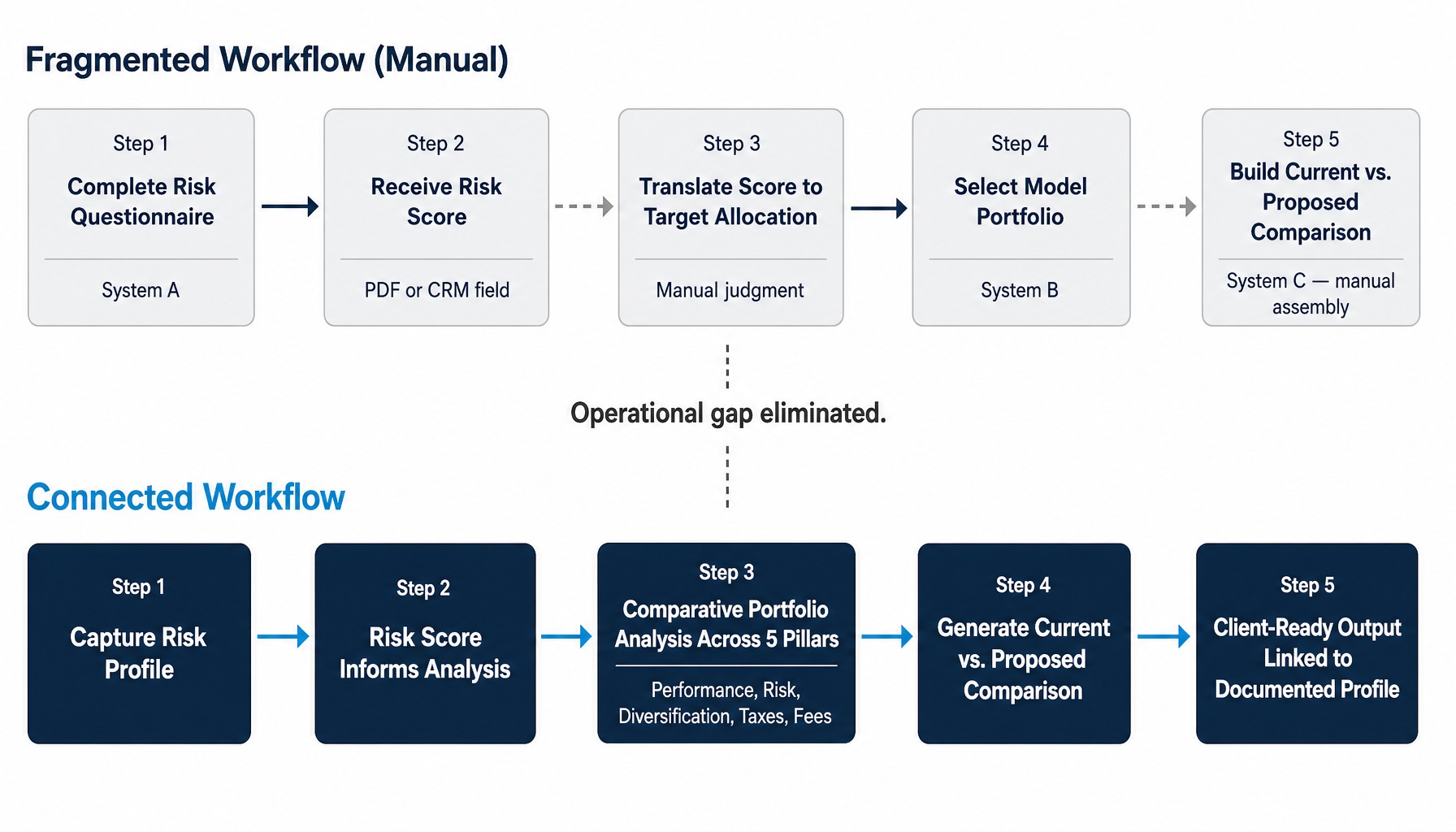
The risk tolerance questionnaire generates a profile that can inform the comparative portfolio analysis and the client-facing conversation that follows, but that is not its only use. Risk profiling can also support financial planning, investment policy development, documentation, and ongoing client reviews. Still, for many firms, the connection to the portfolio conversation is one of the most operationally important handoffs. The questionnaire may live in one system, portfolio analytics in another, and the proposal may be assembled manually in a third. This fragmentation creates a gap where the risk profile is completed but not consistently carried into the analysis or presentation process.
For advisory teams focused on the prospect experience, the time between completing a risk tolerance questionnaire and presenting a clear, personalized portfolio comparison is often where process quality becomes visible. The typical workflow looks like this: an advisor completes a risk assessment, reviews the resulting profile in the context of the broader client information, and then evaluates the prospect's current portfolio against a proposed allocation that reflects the advisor's judgment. This evaluation can include performance, risk, diversification, taxes, and fees. It may also help the advisor identify whether the prospect's current portfolio appears misaligned with the client's documented preferences or financial capacity, which can make the comparative portfolio conversation more relevant and specific.
When these steps are disconnected, the advisor spends valuable preparation time manually bridging systems. They interpret the risk result, determine how it relates to the broader client profile, and then build the current-vs-proposed comparison. The challenge is not that advisor judgment exists. The challenge is that the process can become inconsistent or lightly documented across advisors and offices. In some cases, the risk profile may not visibly appear in the final materials the client sees, which can make the connection between profiling and portfolio discussion less clear.
Read more: Wealth Management Proposal Software in 2026: What the Feature List Doesn't Tell You | VRGL
How VRGL Connects Risk Profiling to the Advice-Preparation Workflow
The fragmentation between risk profiling, comparative portfolio analysis, and proposal creation is an operational challenge that consumes advisor capacity. VRGL is a configurable system of work that helps firms connect these steps more consistently. Discovery and fact-finding remain with the advisor and the firm's existing process.
Within that workflow, firms can configure how risk tolerance questionnaire data and related client profile information are captured and used alongside statement extraction and Comparative Portfolio Analysis. VRGL's role is to support the work behind advice, not to automatically determine suitability, interpret risk scores on the advisor's behalf, or replace advisor judgment. Instead, it helps teams organize the documented profile, evaluate the current portfolio against proposed scenarios across performance, risk, diversification, taxes, and fees, and produce client-ready materials with greater consistency and less manual assembly.
That means the risk profile does not need to remain isolated in a separate tool or PDF if the firm wants it reflected in the broader workflow. How questionnaire results appear in deliverables and how they inform the analysis depends on firm configuration and advisor use. For enterprise firms, this can support a more consistent analytical baseline and better documentation across teams, while preserving flexibility in how advisors interpret and apply the information in their recommendations.
Conclusion
A risk tolerance questionnaire is more than a compliance artifact or a client discovery document. It is an important workflow input that can inform portfolio analysis, proposal generation, and client-facing presentations, while also supporting financial planning, investment policy development, and ongoing client reviews.
Firms that create a more robust process often find success by focusing on a few key areas. Separating behavioral tolerance from financial capacity improves the quality and defensibility of the profile. Incorporating an awareness of behavioral finance improves its durability. Establishing firmwide governance improves its consistency across advisors and offices. Finally, integrating the questionnaire into the broader advice-preparation workflow can help ensure the profile informs the advice conversation rather than simply sitting in a file.
As advisory firms seek to scale and differentiate, those that treat risk profiling as a connected step in a repeatable system of work rather than an isolated checkbox may be better positioned to deliver consistent, well-documented, and personalized client experiences.
See how VRGL connects risk profiling to your acquisition workflow
This article is for informational purposes only and does not constitute investment, legal, or compliance advice. Advisory firms should consult with their own legal and compliance teams to ensure their processes meet all applicable regulatory requirements.
Frequently Asked Questions
How often do advisory firms typically re-evaluate client risk tolerance profiles?
There is no single industry standard. Some firms reassess annually as part of a scheduled review cycle, while others may trigger a reassessment after significant life events (e.g., retirement, inheritance) or major market dislocations. The key consideration is ensuring the existing profile continues to accurately reflect the client's current financial circumstances and behavioral preferences.
What is the relationship between a risk tolerance questionnaire and an investment policy statement?
The risk tolerance questionnaire typically generates one of several inputs that inform an investment policy statement (IPS). The IPS is a broader governing document that may also incorporate the client's time horizon, liquidity needs, return objectives, and specific constraints. The questionnaire output helps establish the risk parameters within the IPS.
How do UHNW households with complex asset structures challenge standard risk scoring?
Ultra-high-net-worth households often hold concentrated positions, illiquid alternatives, and assets across multiple custodians and legal entities. Standard risk questionnaires designed for liquid, single-account portfolios may not capture this complexity. Firms working with these clients often supplement questionnaire data with more detailed analysis of household-level exposures and liquidity constraints.
Can a firm use different risk questionnaire tools across advisors and still maintain governance?
It is possible, though it introduces meaningful complexity. A central issue is that scores from different providers are not necessarily directly comparable, because the tools may measure different dimensions of risk and use different scoring methodologies. Governance in that environment depends less on standardized score mapping alone and more on clear documentation, defined interpretation practices, and an understanding of the limits of cross-tool comparisons.
What documentation considerations may apply to risk tolerance assessments under Reg BI?
Regulation Best Interest requires broker-dealers to act in the best interest of a retail customer, which includes considering their investment profile and risk tolerance. While Reg BI does not prescribe a specific questionnaire format, firms may want to evaluate whether their documentation practices clearly demonstrate how a client's risk profile informed a specific recommendation. Firms should consult their compliance teams for guidance.